Lisbon's 2026 Web Summit was a flurry of dancing humanoid robots, flying cars and agentic assistants. AI was the backbone of it all, dominating the floor across every day. Here are a few key takeaways from this year's summit (from a Product Designer’s perspective).
The design process is dead (or at least upside down)
For years, design has run the same linear path: research, wireframes, mockups, hand-off, development. That order made sense when building was the expensive step, with a high technical barrier to entry. It no longer is.
AI prototypes are a core part of the process for product teams that really ship. On the opening night, Manus co-founder and CPO Tao Zhang said that job roles are dissolving inside his company; people are committing code as well as designing, and designers are writing code too.
When designers contribute to the codebase, the prototype stops being a future vision and becomes a first version.
The opportunity and challenges: where we stand with AI
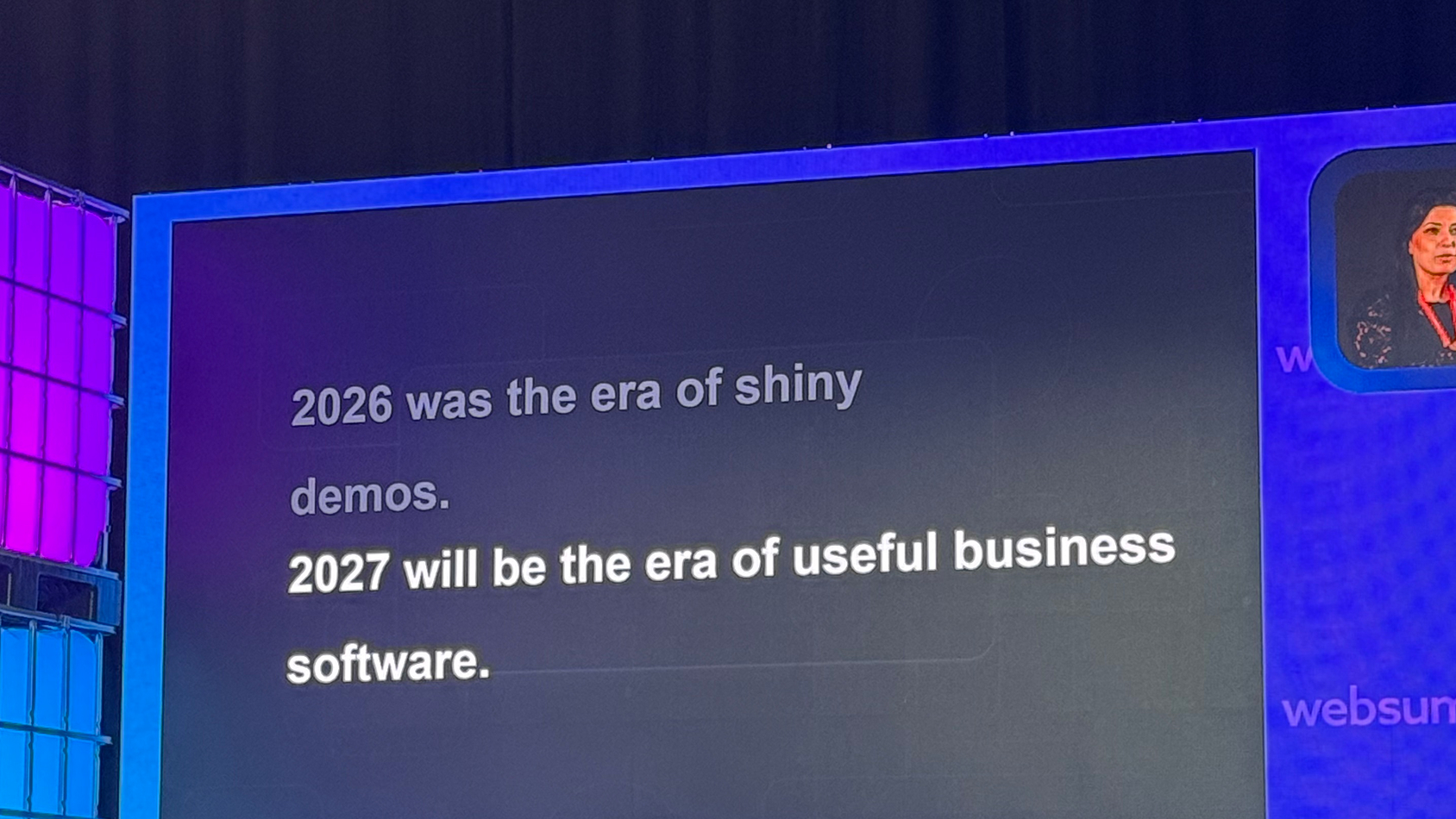
For builders, the biggest opportunities AI offers right now are fast prototyping and making your own tools. Lovable’s CEO Anton Osika argued that enterprise software no longer needs a middleman, because teams can build what they need themselves. Media giant Reuters shared how they’ve created an internal platform for their reporters to build their own agents.
The market is noticing. One exhibitor at the summit, Feedance, reviewed 2,587 startups on the show floor this year and estimated that 27% of them offer core functions that standard AI tooling could largely cover. If a team can build it in an afternoon, buyers will ask why they should pay for it.
This part remains difficult: turning a prototype into business software people can rely on still takes security, permissions, monitoring and strong technical ownership. Making the first version is an easy win. Making it safe enough for someone else to rely on is the hard part, and where all the value sits.
Agents, agents, agents.
If one word rang out across almost every stage in Lisbon, it was agents. Manus opened the conference with their talk “The age of agents”, showcasing how Manus 2.0 gives each agent its own phone number, email address and wallet. Cloudflare's CEO Matthew Prince added that bots, agents included, officially overtook human traffic on the internet this spring.
For software teams, this impacts who is on the team. Manus now hires engineers by watching them solve a problem using its agent, rather than a traditional technical interview.
But trust is still the limit, especially with money. When the main-stage MC asked who uses agents in their personal lives, only a handful of hands went up. That matches recent Visa research showing only 23% of US consumers trust agents to pay for things. For now, the practical wins are internal and low-stakes: to-do lists, Slack briefings and local automations, each with limited data access and human sign-off. These patterns matter just as much when designing and building agentic experiences, since your customers probably won't trust agents any more than you do.
All in all, Lisbon made one thing clear: AI isn't the future, it's the present. The teams that pull ahead will prototype first, build their own tools and design for agents as well as people.
The ones that stay ahead will turn all of that into software others can trust.